 Joseph Plateau created the Phenokistoscope, the Phenokistoscope was a device made of paper disks with the repeating image moving bit by bit on every piece of paper it was made in 1832.
The spinning disk was vertically attached to a handle to a handle with slits in the paper around the edge so when you watch it it looks as if the images are all together like a small movie. The important thing about the device is that the mirrors on the inside were to simply stop the images form blurring together
Charles Emile Reynaud and he created the Praxinoscope , he was a science teacher by day and whenever he had free time he became a inventor and precised a engineer.
After his fathers death in 1865 he continued his studies in Puy-En-Velay. After his studies has finished he had made a optical toy in the year 1876 and in the next year he had patented it on the 21st of December.
The Praxinoscope works by a strip of paper showing 12 frames of images placed around the outer circle.
Eadweard Muybridge
 In 1872, the former governor of California, hired Muybridge for some photographic studies. He had taken a position on a popularly debated question of the day. Whether all four feet of a horse were off the ground at the same time while trotting. The same question had arisen about the actions of horses during a gallop. The human eye could not break down the action at the quick gaits of the trot and gallop. Up until this time, most artists painted horses at a trot with one foot always on the ground; and at a full gallop with the front legs extended forward and the hind legs extended to the rear, and all feet off the ground.
William Horner
William George Horner was born in the year 1786 and died on the 22nd September 1837 was a British mathematician; he was a schoolmaster, headmaster and schoolkeeper, proficient in classics as well as mathematics, who wrote extensively on functional equations, number theory and approximation theory, but also on optics. His contribution to approximation theory is honoured in the designation Horner's method, in particular respect of a paper in Philosophical Transactions of the Royal Society of London for 1819. The modern invention of the zoetrope, under the name Daedaleum in 1834, has been attributed to him.
Horner died comparatively young, before the establishment of specialist, regular scientific periodicals. So, the way others have written about him has tended to diverge, sometimes markedly, from his own prolific, if dispersed, record of publications and the contemporary reception of them.
The zoetrope consists of a cylinder with slits cut vertically in the sides. On the inner surface of the cylinder is a band with images from a set of sequenced pictures. As the cylinder spins, the user looks through the slits at the pictures across. The scanning of the slits keeps the pictures from simply blurring together, and the user sees a rapid succession of images, producing the illusion of motion.
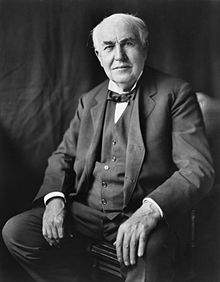 Thomas Alva Edison was born on February 11th, 1847 and died on October 18th, 1931
Edison was also granted a patent for the motion picture camera or "Kinetograph". He did the electromechanical design, while his employee W.K.L. Dickson, a photographer, worked on the photographic and optical development. Much of the credit for the invention belongs to Dickson. In 1891, Thomas Edison built a Kinetoscope, or peep-hole viewer. This device was installed in penny arcades, where people could watch short, simple films. The kinetograph and kinetoscope were both first publicly exhibited May 20, 1891.
In April 1896, Thomas Armat's Vitascope, manufactured by the Edison factory and marketed in Edison's name, was used to project motion pictures in public screenings in New York City. Later he exhibited motion pictures with voice soundtrack on cylinder recordings, mechanically synchronized with the film.
Officially the kinetoscope entered Europe when the rich American Businessman Irving T. Bush bought from the Continental Commerce Company of Frank Z. Maguire and Joseph D. Baucus a dozen machines. Bush placed from October 17, 1894, the first kinetoscopes in London. At the same time the French company Kinétoscope Edison Michel et Alexis Werner bought these machines for the market in France. In the last three months of 1894, The Continental Commerce Company sold hundreds of kinetoscopes in Europe (i.e. the Netherlands and Italy). In Germany and in Austria-Hungary the kinetoscope was introduced by the Deutsche-österreichische-Edison-Kinetoscop Gesellschaft, founded by the Ludwig Stollwerck of the Schokoladen-Süsswarenfabrik Stollwerck & Co of Cologne.
The first kinetoscopes arrived in Belgium at the Fairs in early 1895. The Edison's Kinétoscope Français, a Belgian company, was founded in Brussels on January 15, 1895, with the rights to sell the kinetoscopes in Monaco, France and the French colonies. The main investors in this company were Belgian industrialists.

Georges Méliès was born on the 8th December 1861 and died on the 21st January 1938, full name Marie-Georges-Jean Méliès, was a French illusionist and filmmaker famous for leading many technical and narrative developments in the earliest days of cinema. Méliès, a prolific innovator in the use of special effects, accidentally discovered the substitution stop trick in 1896, and was one of the first filmmakers to use multiple exposures, time-lapse photography, dissolves, and hand-painted color in his work. Because of his ability to seemingly manipulate and transform reality through cinematography, Méliès is sometimes referred to as the first Cinemagician. His films include A Trip to the Moon in 1902 and The Impossible Voyage in 1904, both involving strange, surreal journeys somewhat in the style of Jules Verne, and considered among the most important early science fiction films, though their approach is closer to fantasy. Méliès was also an early pioneer of horror cinema, which can be traced back to his Devil's Castle in 1896.

Animation
Willis O'Brien was a stop motion animator who was influenced by paleontologist as he was working , during his spare time he would take part in sculpting and illustrating which lead him into being employed as a sport cartoonist for Francisco daily news. He had worked on many big films because of his sculpting and illustrating. His first film had drew attention to Thomas Edison's kinectascope and he was employed to animate other films such as King Kong , The lost world and his final film before he had died which was It's a mad mad mad mad world.
George Pal graduated from the Budapest academy of arts with a degree in architecture and advance drawing skills. His parents were stage entertainers. Soon he was employed to Hunnia films in Budapest where he learnt about motion picture cartooning. He deiced to take his own work to Germany and explored ways of making inanimate objects move by using stop motion animation.
The way he made puppets move out of stop motion animation is really great because of how his work turned out, he had put his feelings into one of them which was about the Nazi's invading Holland while he was working with paramount pictures.
This is an example of his work.
Walt Disney started as an animator in 1923 with Alice's Wonderland a film in which a female actor were talking to only animations.His first real piece of whole animation was Snow White and The Seven Dwarfs which was released in 1934, He started to add live action feature alongside their known animation, until recently they specialized in hand drawn animation they released 3D animated film in 2005 with Chicken Little.
 Hayao Miyazaki and studio Ghibli
Hayao Miyazaki is manga artist , animator , illustrator , producer and screen writer. He started his work with Gulliver travels beyond the moon.
Many people had talked about his work but he has had many production being Spirited away, My neighbor totoro ect.
Here is an example of his work.
Tim Burton
Tim Burton by far is one of my favorite animators as he is all about scary and creepy , most of his animations are black and white Like Corpse bride and frankenwinie but one of his best animations is The Nightmare Before Christmas. He started at the age of 13 and has turned into a brilliant director.
Pixar


Dreamworks
Dreamworks is a great animation studio which has made many sad and funny studio's, no matter how serious the film may be they always manage to find a way to put comedy into it. It is a animation based company only.
The company have made great films from our green lovable ogre to wanting our own night fury from how to train your dragon.

Nick Park
Nice park is a great stop motion animator, he is the creator of creature comforts which is hilarious and he is also famous for Wallace and Gromit, Chicken Run and Shawn the Sheep. Wallace and Gromit take a lot of time and effort to animate but that is what Nick Park loves doing , the movie Curse of the Ware-rabbit was a great success and only goes to show even if the clay is small you can still make a great movie out of it.
The television show that I have chosen is Creature comforts because it is a fully animated interview and the things that the creatures say is hilarious.
For my movie I have chosen the movie Coraline, it was directed by Tim Burton which means the movie may be for children but it will always have something either creepy or scary.
For the advert I have chosen the Sony Bravia advert as it was filmed in new York and took ages to make as they required a lot of clay to make every single bunny.
Here is how it was made
Music videos can be made in many ways but there are some music video's that look brilliant and there are some artists that wanted their music videos in stop motion animation, here is an example
The animated mouth action on gilded front woman Dede Wegg-Prosser reminds me a little bit of South Park, don’t you think? A production team shot “You Came Out” over two days, using 4,816 still images.
Channel Idents
 Channel Idents are what pop up every once and a while to remind us what channel we are watching, for example, channel four will have houses in the shape of a four , BBC 3 will have comedy since its a comedy channel.
Webisodes
A webisode is a series of episode you can only watch online , they are not turned into movies or seen on television and only aired online or on you tube. An example is Don't Hug Me I'm Scared.
For the last part of the history of animation, I will give two short paragraphs on who is stop motion animation for and what does the future hold for stop motion animation.
I think that stop motion animation is for everyone, it can be for adults and children, examples of the movies for children is Coraline and Wallace and gromit curse of the ware rabbit , everyone knows who they are and there creator Nick Park while an adult film with stop motion animation is King Kong (1933)
I think that the future holds a lot for stop motion animation as we are getting more into the technology age which means we will come up with more idea's for stop motion animation and to make it look great, we could even make an idea of speeding up the process of how long it takes to film.

No comments:
Post a Comment